
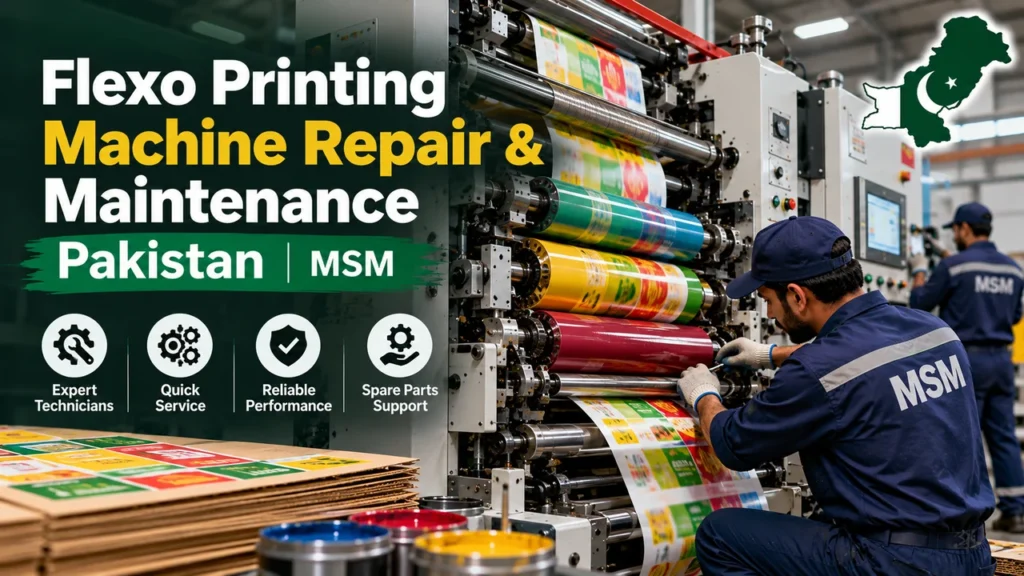
A corrugated box can be structurally perfect and still be rejected because the printing is inaccurate.
Misregistration, uneven ink transfer, feeding problems and mechanical instability can affect branding, product information and the final appearance of packaging.
Micro Star Machines provides flexo printing machine repair and maintenance for corrugated packaging manufacturers operating different printing configurations.
Factories can review MSM’s existing range of flexo printing machines to understand how this equipment fits into modern corrugated-box production.
Common Flexo Printing Machine Problems
Typical problems include:
- Poor registration
- Uneven printing
- Blurred text or graphics
- Missing print areas
- Excessive ink transfer
- Irregular sheet feeding
- Roller vibration
- Printing-unit misalignment
- Motor or drive faults
- Sensor problems
- Mechanical noise
- Reduced production speed
When a printing fault repeatedly interrupts production, MSM’s technical support team can be involved in diagnosing whether the problem relates to operating parameters, controls or machine components.
Flexo Machine Inspection
The visible printing problem is not always the root cause.
Inspection may include:
- Feeding system
- Printing cylinders
- Anilox rollers
- Printing rollers
- Registration system
- Gears
- Bearings
- Ink circulation
- Motors
- Drives
- Sensors
- Electrical components
For factories using printing and slotting together, the condition of the rotary slotter machine should also be considered when the final carton shows dimensional or slotting errors after printing.
Preventive Maintenance
Flexo machines should be cleaned and inspected routinely.
Maintenance can include:
- Roller cleaning
- Lubrication
- Bearing checks
- Gear inspection
- Registration checks
- Sensor cleaning
- Fastener inspection
- Electrical inspection
- Ink-system cleaning
Where worn components are identified, factories can use MSM’s spare parts service to coordinate suitable replacement requirements rather than delaying action until a complete machine stoppage occurs.
Repairing Printing and Die-Cutting Lines
Many corrugated plants combine printing with downstream cutting.
When printed sheets move into a rotary die machine, accurate feeding and registration become particularly important because printing and die-cutting errors can compound each other.
Maintenance should therefore consider the complete converting sequence.
Printing Before Folding and Gluing
After printing and cutting, cartons often move into finishing.
Factories using an automatic or semi-automatic folder gluer need correctly printed and dimensionally accurate sheets before the folding stage begins.
An upstream registration problem can consequently appear as a finished-box quality problem later in production.
Understanding the Complete Factory Workflow
Machine maintenance becomes easier when operators understand the role of every production stage.
MSM’s guide explaining the machinery required for a corrugated box factory shows how printing sits between board production and subsequent slotting, die cutting, gluing and stitching operations.
This broader understanding can help teams diagnose whether a defect actually originates in the flexo printer or elsewhere.
Improve Operator Understanding
A technically sound machine can still produce poor output when settings are incorrect.
MSM’s dedicated machine training service is relevant for factories that want operators and maintenance personnel to better understand machine settings, production practices and routine maintenance.
Planning Corrugated Printing Capacity
Businesses expanding into larger corrugated operations should also coordinate printing capacity with the complete corrugated production line so board output does not exceed the practical capacity of printing and finishing departments.
Balanced machinery improves overall factory workflow.
FAQs
What causes poor flexo print registration?
Possible causes include feeding inconsistencies, mechanical wear, incorrect settings, cylinder issues or alignment problems.
Can operators prevent flexo machine problems?
Daily cleaning, inspection and correct operation can prevent many avoidable issues.
When should rollers be inspected?
Rollers should be checked whenever print quality changes or as part of the machine’s regular maintenance schedule.