
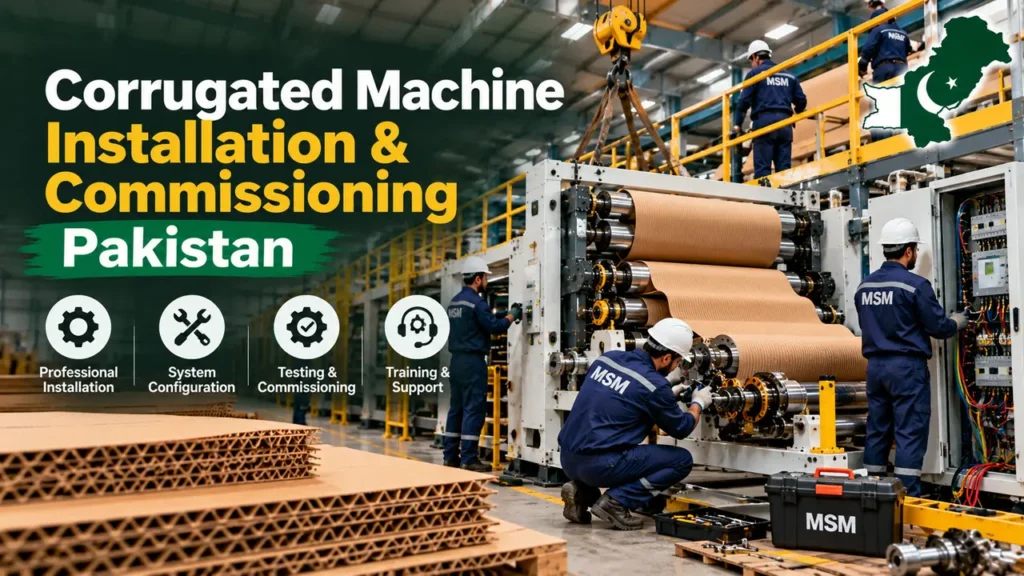
Purchasing machinery is only one part of establishing a corrugated production operation.
Correct positioning, alignment, utilities, testing and commissioning determine whether the machinery can transition successfully from delivery to commercial production.
MSM’s existing service pack already includes installation-oriented support, making professional setup an important part of the company’s after-sales approach.
Installation Planning Starts Before Delivery
Factories should plan the machine layout before equipment reaches the site.
Manufacturers preparing a new plant can use MSM’s guide to the machinery required for a corrugated box factory to identify the different areas needed for corrugation, printing, cutting, gluing, stitching and material handling.
Installation planning should consider:
- Factory dimensions
- Machine footprint
- Material flow
- Electrical supply
- Compressed air
- Steam where required
- Maintenance access
- Raw material storage
- Finished-product storage
- Operator access
- Future expansion
Installing a Complete Corrugated Production Line
A complete corrugated production line includes multiple sections that need to operate as a coordinated system.
Positioning one section incorrectly can affect the alignment and material flow of downstream equipment.
Factories should therefore treat complete-line installation differently from placing one independent machine.
Installation for 3-Ply Production
Businesses planning lighter and general-purpose board can review the existing 3-ply corrugated production line guide while defining requirements such as board width, flute profile, production speed and downstream converting capacity.
These specifications influence layout and commissioning.
Installation for 5-Ply Production
A 5-ply corrugated production setup involves additional corrugation and bonding processes, meaning space, utilities and line balance become even more important during installation planning.
Manufacturers should define their final board requirements before equipment positioning begins.
Individual Machine Installation
Factories upgrading one section may install only a new machine instead of a complete line.
For example, integrating a single facer machine into an existing corrugator requires attention to speed compatibility, material flow, alignment and the capabilities of surrounding machinery.
Adding one high-speed machine will not necessarily increase factory output if downstream equipment remains the bottleneck.
What Happens During Commissioning?
Installation puts machinery into position.
Commissioning determines whether it operates correctly.
A typical sequence may include:
- Mechanical inspection
- Electrical inspection
- Lubrication checks
- Safety checks
- No-load testing
- Individual machine testing
- Integrated production testing
- Parameter adjustment
- Output inspection
- Operator handover
During this stage, MSM’s operator training service can help factory personnel understand machine controls, startup procedures and operating practices while the equipment is being brought into production.
Commissioning Is More Than Starting the Machine
A machine turning on successfully does not mean the production setup is optimized.
Commissioning should observe:
- Feeding
- Alignment
- Speed
- Bonding
- Cutting
- Printing
- Finished dimensions
- Board quality
- Safety systems
When controls or operating parameters require additional troubleshooting, factories can also use MSM’s technical support during the stabilization process.
Plan for Future Expansion
A new installation should leave room for growth where practical.
Businesses considering a complete plant can review MSM’s packaging machinery range before finalizing the layout so future printers, die cutters, gluers or other equipment can be integrated more easily.
FAQs
What information is needed before installation?
Factory dimensions, machine configuration, electrical load, required utilities and production-flow information should be prepared.
What is the difference between installation and commissioning?
Installation physically sets up the machinery; commissioning tests, adjusts and verifies it for production.
Is operator training part of commissioning?
Training is particularly useful during commissioning because operators can learn directly on the installed equipment.