
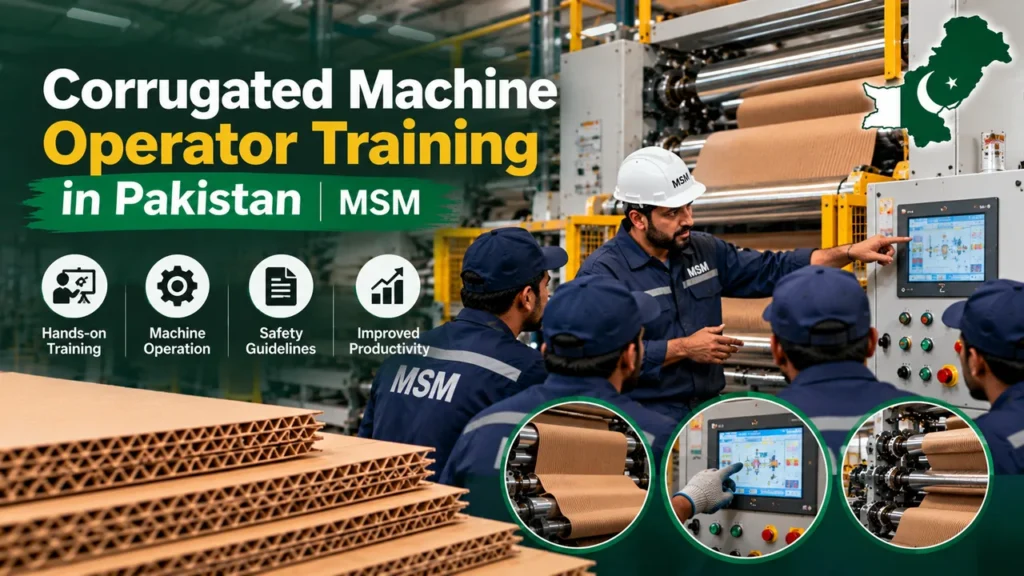
Advanced machinery cannot deliver consistent results if the people operating it do not understand its controls, settings and maintenance requirements.
Micro Star Machines provides corrugated machine operator training, while MSM’s existing training service is designed to help operators and maintenance personnel understand machine operation and improve corrugator efficiency.
Why Machine Operator Training Matters
Operators influence production throughout every shift.
They monitor:
- Machine startup
- Speed
- Feeding
- Temperature
- Pressure
- Alignment
- Product quality
- Cleaning
- Lubrication
- Basic adjustments
- Shutdown procedures
Incorrect settings can increase waste even when nothing is mechanically wrong with the machine.
Single Facer Operator Training
Operators working with a single facer machine need to understand how flute formation, heat, pressure and adhesive bonding influence corrugated-board quality.
They should be able to identify warning signs such as:
- Poor flute formation
- Weak bonding
- Uneven paper movement
- Abnormal vibration
- Excessive noise
Early recognition can prevent unnecessary production losses.
Flexo Printing Operator Training
Printing requires a different skill set.
When operators work with flexo printing machines, they should understand registration, feeding, ink control, cleaning and basic machine adjustments.
Incorrect setup can result in large quantities of printed cartons being rejected before anyone identifies the problem.
Slitting and Scoring Training
The slitter scorer requires operators to understand sheet dimensions, cutting positions and scoring requirements.
A small dimensional mistake at this stage can create problems during folding and box assembly.
Training therefore needs to connect machine settings with the final box specification.
Folder Gluer Training
Operators responsible for an automatic or semi-automatic folder gluer should understand feeding, alignment, adhesive application, folding and pressing.
Training can help teams distinguish between an operating adjustment and a genuine mechanical problem.
Stitching Machine Training
Factories using an automatic stitcher with folder gluer need operators who can manage a more integrated finishing process without relying entirely on trial and error.
Where production uses standalone stitching, personnel working with a semi-auto stitcher should likewise understand setup, box dimensions and routine machine inspection.
Daily Operator Maintenance
Operators are normally the first people to notice changes in machine behavior.
They should be trained to check:
- Lubrication points
- Unusual noise
- Vibration
- Loose fasteners
- Sensors
- Feeding behavior
- Product dimensions
- Output quality
- Safety guards
Operators should not attempt repairs beyond their training.
When a problem exceeds routine adjustments, MSM’s technical support service provides a route for escalating the issue instead of continuing to operate faulty equipment.
Training for Complete Production Teams
A corrugated factory contains several interdependent machines, so operators benefit from understanding the overall workflow.
Reviewing the complete corrugated production line can help personnel understand what happens before and after their own machine and why upstream defects often create downstream production problems.
When Should Training Be Conducted?
Training is especially valuable:
- During new installation
- During commissioning
- After recruiting new operators
- After upgrading machinery
- When waste increases
- When repeated operating mistakes occur
- When production specifications change
Refresher training can also be useful for experienced teams when new equipment or control systems are introduced.
FAQs
Who should receive training?
Machine operators, shift supervisors and relevant maintenance personnel can all benefit.
Can existing operators receive refresher training?
Yes. Training can be useful when machinery changes or recurring operational problems appear.
Does training replace technical maintenance?
No. Operators handle routine operation and basic checks; technical maintenance should be performed by appropriately qualified personnel.