
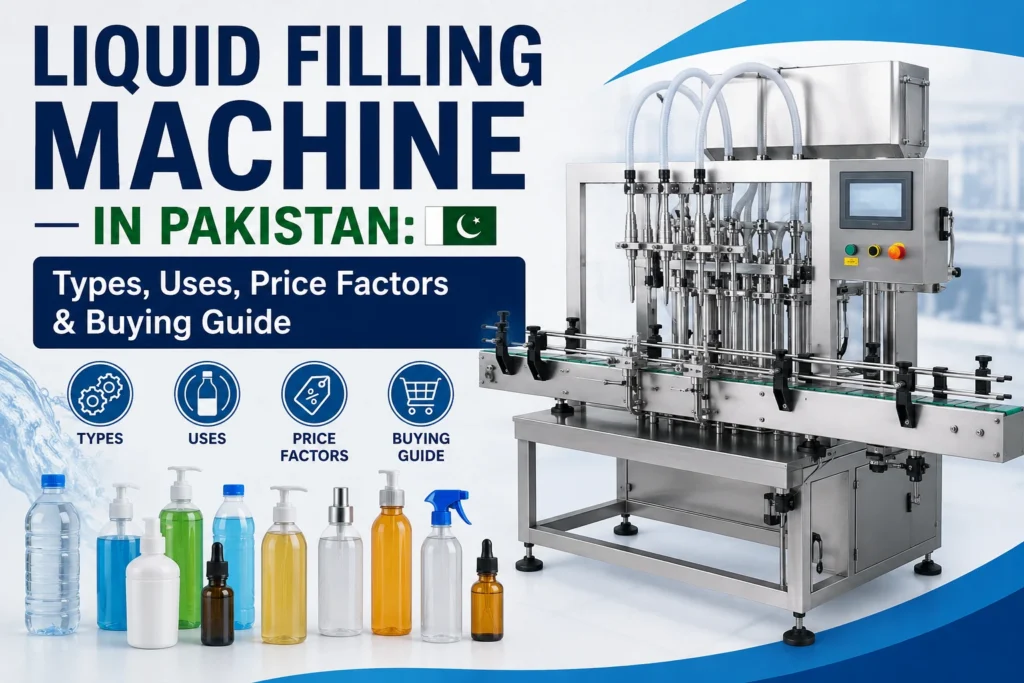
A liquid filling machine is one of the most useful machines for businesses that pack liquids in bottles, jars, cans, or containers. It is used in food, beverages, cosmetics, pharmaceuticals, chemicals, detergents, oils, and many other industries.
Manual filling may work at the start, but it becomes slow and messy when production grows. Workers may fill one bottle more and another bottle less. The product gets wasted. Bottles look unprofessional. Production becomes difficult to manage.
A liquid filling machine solves these problems by filling a fixed quantity of liquid into each container at a better speed and accuracy. For businesses in Pakistan, especially those already using a food packaging machine in Pakistan for dry or semi-solid products, liquid filling becomes the next important step when they expand their product line.
What Is a Liquid Filling Machine?
A liquid filling machine fills liquid products into bottles or containers. The machine controls the quantity, speed, and flow of the liquid during filling.
Some machines are simple and work with manual support. Some are semi-automatic and need one or two operators. Fully automatic machines can fill, move, and sometimes connect with capping and labeling systems.
The right machine depends on your product, production size, bottle type, and budget. A water bottle company will not need the same machine as a shampoo brand, and a brand packing chips through a snack packaging machine will have completely different needs from a company filling oil or syrup.
Products That Need Liquid Filling Machines
Liquid filling machines are used for many products, but every product behaves differently. Some liquids flow like water. Some are sticky and thick. Some create foam. Some need food-grade or pharma-grade contact parts.
Common products include:
| Product Category | Examples |
| Beverages | Water, juice, milk drinks, vinegar |
| Food products | Sauces, syrups, honey, edible oil |
| Cosmetics | Shampoo, lotion, hair oil, face wash |
| Pharma products | Syrups, tonics, herbal liquids |
| Chemicals | Detergent, sanitizer, phenyl, cleaner |
| Industrial liquids | Lubricants, chemicals, liquid fertilizers |
Before buying a machine, always check the nature of your liquid. Dry products need a different setup, so a business packing spices or grains may need a granule packing machine in Pakistan instead of a liquid filling machine.
Types of Liquid Filling Machines
Different filling systems are made for different liquids. A machine that works well for water may not work properly for honey or shampoo.
Gravity Liquid Filling Machine
A gravity filling machine is usually used for thin liquids. These liquids flow easily without pressure.
It is suitable for:
- Water
- Juice
- Vinegar
- Sanitizer
- Thin chemical liquids
This machine is simple, easy to operate, and useful for businesses that fill free-flowing liquids.
Piston Liquid Filling Machine
A piston filling machine is better for thick liquids. It pulls the product into a cylinder and then pushes a fixed quantity into the bottle.
It is suitable for:
- Honey
- Sauce
- Shampoo
- Lotion
- Syrup
- Creamy liquids
This machine gives better control when the liquid is thick or sticky.
Pump Filling Machine
A pump filling machine uses a pump to move liquid from the tank to the container. It can handle different types of liquids depending on the pump type.
It is commonly used for:
- Oils
- Detergents
- Cosmetics
- Chemicals
- Medium-viscosity liquids
This option works well for businesses that fill different liquid products in different bottle sizes.
Overflow Filling Machine
An overflow filling machine is used when bottle appearance matters. It fills bottles to the same visible level, even when the actual bottle size has a slight variation.
It is mostly used for transparent bottles where customers can see the fill level.
Good for:
- Mineral water
- Cleaners
- Beverages
- Thin liquids in clear bottles
Volumetric Liquid Filling Machine
A volumetric filling machine fills a fixed volume of liquid, such as 100ml, 250ml, 500ml, or 1 liter.
This is useful when the exact quantity matters. Many food, cosmetic, and chemical businesses use volumetric filling machines because they need controlled filling with less wastage.
Manual, Semi-Automatic, and Automatic Liquid Filling Machines
Every business does not need a fully automatic machine from day one. The right choice depends on your daily production.
Manual Liquid Filling Machine
A manual filling machine is suitable for very small production. It is low-cost and simple, but it depends heavily on labor.
It can work for startups, testing, sampling, and small batches.
The limitation is speed. It is not suitable for serious production or regular factory work.
Semi-Automatic Liquid Filling Machine
A semi-automatic machine is a practical option for small and medium businesses. The operator places bottles under the nozzle, and the machine fills the set quantity.
It gives better accuracy than manual filling and reduces product wastage.
Many growing businesses in Pakistan prefer semi-automatic machines because they are affordable and easier to manage.
Automatic Liquid Filling Machine
An automatic liquid filling machine is used for higher production. It can work with conveyors and multiple filling heads. Bottles move through the line, get filled, and then move to the next stage.
When production becomes regular, many factories shift from separate machines to an automatic packaging machine in Pakistan so filling, capping, labeling, and coding can work in a smoother flow.
Automatic machines can also connect with:
- Capping machine
- Labeling machine
- Coding machine
- Sealing machine
- Conveyor system
This setup creates a proper packaging line.
How a Liquid Filling Machine Works
The working process is simple.
First, the liquid is placed in the tank or connected through a supply line. Then bottles are placed manually or moved through a conveyor. The machine measures the required quantity and fills each bottle through nozzles.
After filling, the bottle moves to the next process. This can be capping, sealing, labeling, or coding.
In some factories, liquid filling runs beside other packing lines, while a vertical form fill seal machine in Pakistan handles pouch-based products on a separate production section.
How to Choose the Right Liquid Filling Machine
Many buyers make the mistake of asking only one question: “What is the price?”
Price matters, but it should not be the first deciding point. The first question should be: “Which machine is right for my product?”
Check the Thickness of the Liquid
Thin liquids and thick liquids need different systems.
Water, juice, and sanitizer are easy to fill. Honey, shampoo, lotion, and sauce need more force and better control. Thick products may also need special nozzles, heating options, or stronger pumps.
Always share a sample of your product or complete product details before finalizing the machine.
Know Your Filling Volume
You should know the bottle sizes you want to fill.
Common filling ranges include:
- 50ml
- 100ml
- 250ml
- 500ml
- 1 liter
- 5 liters
Some machines can handle multiple filling ranges, but the setup must be planned properly.
Calculate Daily Production
A small business filling a few hundred bottles per day has different needs from a factory filling thousands of bottles.
Production target helps decide:
- Number of filling heads
- Machine speed
- Conveyor size
- Tank capacity
- Automation level
Do not buy a machine only for your current production. Think about the next 1 to 2 years as well. A slightly better machine can support business growth without forcing another quick upgrade.
Select the Right Number of Filling Heads
Filling heads directly affect production speed.
A single-head machine fills one bottle at a time. A double-head machine fills two bottles. A 4-head, 6-head, or 8-head machine can handle higher production.
More heads mean better speed, but they also increase machine cost and space requirement.
Check Bottle Shape and Material
Bottle shape can affect filling performance. Round bottles, square bottles, plastic bottles, glass bottles, jars, and cans may need different handling.
The machine should match your container size, neck diameter, and filling style.
Plan the Full Packaging Line
Filling is only one part of packaging.
After filling, you may need:
- Bottle capping
- Jar sealing
- Labeling
- Batch coding
- Shrink wrapping
- Carton packing
Some brands use bottles, while others pack products in flexible packs, so a pouch packing machine may also become part of the packaging plan when the product range grows.
Liquid Filling Machine Price in Pakistan
The price of a liquid filling machine in Pakistan depends on machine type, automation level, filling range, number of heads, material quality, and customization.
A small manual or semi-automatic machine costs less than a complete automatic filling line. A simple water filling machine will also cost less than a machine made for thick liquids like honey, shampoo, or sauce.
Main price factors include:
- Manual, semi-automatic, or automatic system
- Number of filling nozzles
- Stainless steel quality
- Filling volume range
- Product thickness
- Bottle size and shape
- Conveyor system
- Capping and labeling integration
- PLC control system
- Custom design requirement
- Installation and training support
For Pakistani businesses, after-sales support is just as important as price. A low-cost machine can become expensive if spare parts are not available or the supplier does not provide proper technical support.
Industries Using Liquid Filling Machines in Pakistan
Pakistan has a strong demand for packaging machinery because many small and medium businesses are moving from manual packing to machine-based production.
Food and Beverage Industry
Food and beverage companies use liquid filling machines for water, juices, sauces, vinegar, syrups, milk-based drinks, and edible oils.
Clean filling and accurate quantity are very important in this industry because customers judge the product by packaging quality.
Cosmetics and Personal Care
Cosmetic brands use filling machines for shampoo, lotion, hair oil, face wash, toner, and liquid creams.
These products need neat filling because leakage or uneven quantity damages brand image.
Pharmaceutical Industry
Pharma companies use liquid filling machines for syrups, tonics, and other oral liquids.
This industry needs better hygiene, accurate quantity, and reliable machine performance.
Chemical and Detergent Industry
Chemical companies use liquid filling machines for detergents, cleaners, phenyl, sanitizers, lubricants, and industrial liquids.
Some products create foam or have strong chemical properties, so the machine material and filling system must be selected carefully.
Agriculture Industry
Agriculture businesses use these machines for liquid fertilizers, pesticides, and plant nutrients.
Strong packaging matters here because these products are often transported in bulk and stored in tough conditions.
Common Mistakes Buyers Make
Many buyers face problems after purchasing a machine because they rush the process. These mistakes are common.
Buying Only Because the Price Is Low
A cheap machine may look attractive, but it may not match your product. Poor accuracy, weak parts, leakage, and slow speed can create bigger losses later.
Ignoring Product Viscosity
This is one of the biggest mistakes. A machine suitable for water may not fill shampoo or honey properly.
Choosing the Wrong Filling Range
Some buyers buy a machine for one bottle size and later want to fill other sizes. Always discuss your current and future bottle range before buying.
Not Checking Spare Parts
Spare parts availability matters a lot. If a small part stops working and you cannot find a replacement, your full production can stop.
Not Planning Capping and Labeling
Filling speed alone does not matter if capping and labeling are still slow. A balanced packaging line gives better output.
Skipping Product Testing
For thick, foamy, or chemical liquids, testing is important. It helps confirm filling accuracy, nozzle performance, and machine suitability.
Maintenance Tips for Liquid Filling Machines
A liquid filling machine performs better when operators clean and maintain it properly.
Clean the tank, pipes, and nozzles after production. This is especially important for food, pharma, cosmetics, and sticky products.
Check seals, pipes, valves, and nozzles regularly. Small leakage can waste product and affect filling accuracy.
Calibrate the filling volume when needed. Regular calibration helps maintain the same quantity in every bottle.
Keep electrical parts safe from water and chemical contact. Train operators so they understand the basic machine settings and cleaning process.
A machine does not fail only because of poor build quality. Many machines fail early because operators do not clean them properly or use them without basic training.
Why Buy a Liquid Filling Machine from Micro Star Machines?
Micro Star Machines helps businesses choose practical packaging machinery according to their product, bottle size, production target, and budget.
For liquid filling, the machine must match the product. Water, oil, shampoo, syrup, detergent, and chemicals do not behave the same way during filling. In the same way, dry materials require a different machine, and a powder packing machine in Pakistan is a better option when the product is flour, spices, milk powder, or similar powdered material.
You can discuss:
- Product type
- Filling volume
- Bottle or container size
- Daily production target
- Required automation level
- Capping and labeling needs
- Space and installation requirements
Micro Star Machines also supports businesses with machine selection, installation guidance, operator understanding, and spare parts support. This is important for manufacturers who want long-term production, not just one-time machine purchase.
Final Thoughts
A liquid filling machine can improve production speed, reduce wastage, and give your product a cleaner packaging finish. But the machine should match your liquid type, bottle size, and production target.
Do not choose a machine only by looking at price. Check the filling system, accuracy, material quality, support, and future production needs.
For small businesses, a semi-automatic machine can be a practical start. For factories, an automatic liquid filling line can save time, reduce labor, and improve consistency.
Need a Liquid Filling Machine for Your Product?
Share your product type, bottle size, and daily production target with Micro Star Machines. Our team will help you choose the right liquid filling machine for your business, whether you need a simple semi-automatic setup or a complete automatic filling line.