
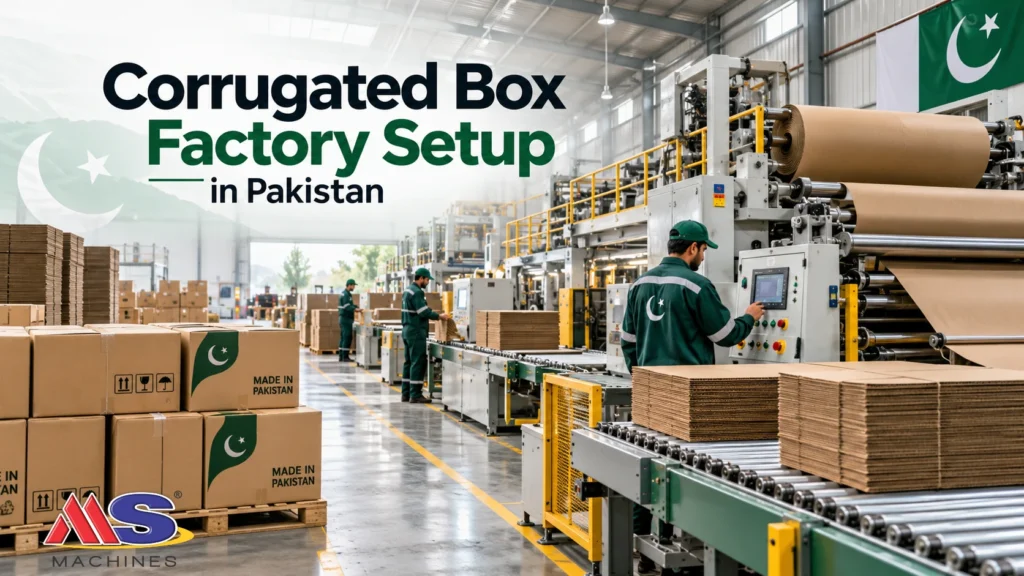
Starting a corrugated box factory in Pakistan can create opportunities to supply packaging to food companies, textile exporters, electronics manufacturers, pharmaceutical businesses, FMCG companies, e-commerce sellers, appliance manufacturers, agricultural businesses, and many other industries.
However, success depends heavily on selecting the right business model and machinery before production begins.
Step 1: Decide What Type of Corrugated Factory You Want
There are two broad approaches.
Corrugated Box Converter
A converter purchases ready-made corrugated sheets and turns them into finished cartons.
Processes may include:
- Printing
- Slotting
- Die cutting
- Folding
- Gluing
- Stitching
This model can require less machinery than manufacturing board from paper reels.
Integrated Corrugated Factory
An integrated factory can manufacture corrugated board and then convert that board into finished boxes.
This involves more machinery, factory space, utilities, raw-material storage, and process planning.
Businesses comparing converting equipment can examine a carton box making machine in Pakistan while deciding how much of the manufacturing process they want to handle internally.
Step 2: Identify Your Target Customers
Do not purchase machinery before understanding who will buy your boxes.
Potential customers include:
- Textile manufacturers
- Food processors
- Pharmaceutical companies
- E-commerce brands
- Shoe manufacturers
- Electronics businesses
- Auto-parts manufacturers
- Exporters
- FMCG companies
- Fruit and agricultural businesses
Different customers require different box sizes, strengths, print quality, and order volumes.
Step 3: Plan Printing Requirements
Many customers require their boxes to carry logos and product information.
A factory planning printed cartons may incorporate a flexo printing machine in Pakistan into the production workflow so printing can be coordinated with cutting and finishing operations.
Determine whether the majority of customers require one-color, two-color, or more complex printed boxes.
Step 4: Determine Factory Capacity
Do not calculate production capacity using only your first few customers.
Consider:
- Daily orders
- Average sheet size
- Peak demand
- Number of shifts
- Machine utilization
- Maintenance downtime
- Product changeovers
- Future growth
Factories considering multiple types of packaging machinery can also review industrial packaging equipment in Pakistan while planning future diversification beyond corrugated cartons.
Step 5: Plan Raw Materials
Corrugated box production requires appropriate paper and consumables.
Depending on the setup, requirements can include liners, fluting material, adhesive, printing ink, stitching wire, and other production supplies.
Businesses researching paper manufacturing more broadly can also study how a kraft paper making machine relates to the wider paper and corrugated packaging supply chain before deciding which stage of production they intend to enter.
Step 6: Select the Location
Location affects transportation, labor availability, customer access, utility availability, and factory cost.
Faisalabad can be particularly relevant for corrugated packaging because of its large textile and manufacturing base. Entrepreneurs exploring a packaging machine in Faisalabad can evaluate potential industrial customers before determining factory capacity.
Other major industrial markets include Lahore, Karachi, Gujranwala, Sialkot, Sheikhupura, Multan, and Gujrat.
Step 7: Design the Factory Layout
A factory should not be designed by placing machines wherever space is available.
Plan the movement of:
Raw materials → production → conversion → finishing → quality inspection → finished goods → dispatch
Also allocate space for:
- Paper storage
- Ink and consumables
- Finished boxes
- Scrap
- Maintenance
- Electrical equipment
- Offices
- Loading
- Forklift or trolley movement
Step 8: Calculate Investment Beyond Machinery
Machinery is only one part of the project.
Budget for:
- Factory building or rent
- Electrical work
- Installation
- Raw materials
- Labor
- Working capital
- Transport
- Printing plates
- Maintenance
- Sales and marketing
- Inventory
- Utilities
This provides a much more realistic investment estimate.
Step 9: Start With the Right Product Mix
A new factory does not necessarily need to manufacture every possible box.
It may be better to build a strong customer base around standard shipping cartons before adding specialized die-cut packaging, higher-end printing, or additional board structures.
Machinery can then be expanded according to real demand.
Micro Star Machines
Micro Star Machines can discuss machinery requirements with businesses planning corrugated box manufacturing operations in Pakistan.
Before requesting a quotation, prepare details about your intended board structure, box dimensions, production capacity, printing requirements, factory area, and target market.
A properly planned factory begins with the market and production workflow—not with purchasing machines at random.