
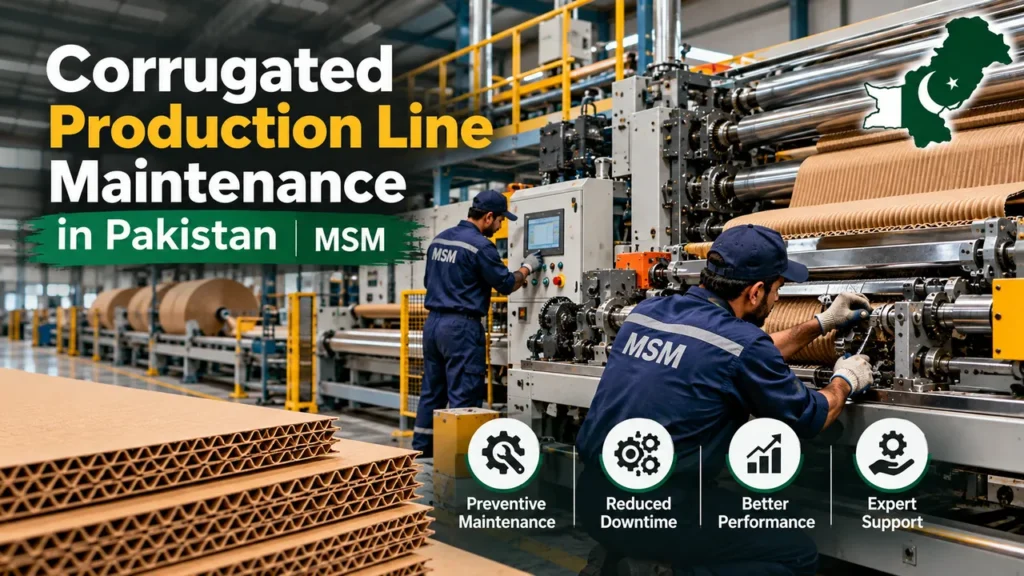
A corrugated production line combines several machines into one continuous manufacturing process. Paper feeding, flute formation, bonding, heating, tension control, slitting, scoring and cutting must remain synchronized for stable production.
Factories operating a complete corrugated production line therefore need to maintain the system as one connected line instead of servicing every machine only after it fails.
Micro Star Machines provides corrugated production line maintenance for factories looking to reduce breakdowns, maintain consistent board quality and improve equipment reliability.
Why Preventive Maintenance Matters
Unexpected breakdowns usually cost more than planned maintenance because they interrupt production without warning.
Regular inspection can identify:
- Bearing wear
- Loose components
- Alignment problems
- Lubrication issues
- Roller wear
- Electrical faults
- Sensor abnormalities
- Air leakage
- Drive problems
- Heating inconsistencies
A factory can combine routine inspections with MSM’s broader service pack to build a more structured approach to after-sales maintenance and technical support.
Maintenance of the Single Facer Section
The corrugating process begins with machinery responsible for producing the flute.
Because the single facer machine directly influences flute consistency, bonding and board strength, rollers, bearings, heating, pressure settings and adhesive performance should be monitored regularly.
Changes in flute quality can be an early sign that the machine requires inspection.
Bridge and Tension Control
Corrugated production is also affected by what happens between major machine sections.
A properly operating corrugated bridge system helps control tension, sheet accumulation and material flow between the single facer and downstream sections.
Poor tension control can contribute to:
- Board deformation
- Misalignment
- Irregular material flow
- Unstable downstream production
Slitting and Scoring Maintenance
The slitter scorer performs precision cutting and scoring before board enters downstream conversion.
Blades, scoring wheels, positioning mechanisms and feeding systems should therefore be inspected for wear and alignment.
A small scoring error repeated across thousands of sheets can create significant production waste.
Cutting Accuracy
The production line eventually needs to cut continuous board into accurate sheet dimensions.
When an NC cutter starts producing inconsistent sheet lengths, the problem should be investigated before inaccurate board enters printing or box conversion.
Operators should monitor dimensional accuracy as part of routine quality control.
Electrical and Control-System Maintenance
Modern corrugated equipment depends heavily on sensors, motors, drives and control systems.
MSM’s technical support service can assist with diagnostic support where operating parameters or control-related problems require additional investigation.
Electrical cabinets should also be kept clean and inspected according to appropriate industrial maintenance procedures.
Keep Essential Spare Parts Available
Factories should identify components capable of stopping production completely.
Rather than waiting for a critical failure, manufacturers can coordinate through MSM’s spare parts support to plan availability for relevant replacement components.
The correct spare-parts inventory depends on the equipment installed and its operating history.
Maintenance Frequency
There is no single maintenance interval that fits every factory.
Frequency depends on:
- Daily operating hours
- Number of shifts
- Machine age
- Production speed
- Factory environment
- Paper quality
- Existing equipment condition
- Previous breakdown history
Manufacturers comparing new production configurations can also review MSM’s 3-ply versus 5-ply corrugated production guide because more complex board structures can involve additional equipment and process-control requirements.
Signs Your Production Line Needs Maintenance
Arrange an inspection if you notice:
- Increasing waste
- Slower output
- Frequent small stoppages
- Uneven flute formation
- Weak bonding
- Board warping
- Excessive vibration
- Unusual noise
- Cutting inaccuracies
- Recurring alarms
Maintenance should focus on keeping production stable rather than simply making a machine run until the next breakdown.
FAQs
How often should a corrugated production line be maintained?
The interval depends on machine specifications, workload and operating conditions. Daily operator checks should normally be supplemented by scheduled technical maintenance.
Can maintenance reduce waste?
Yes. Correct alignment, cutting, bonding and process settings can reduce avoidable production waste.
Should a complete line be stopped for maintenance?
Some procedures require planned downtime, while others can be performed during normal inspection periods.