
A factory can manage manual packing in the beginning. A few workers can fill bottles, seal pouches, paste labels, pack cartons, and dispatch orders. But once daily production increases, the same manual process starts creating issues.
Weights become different. Seals become weak. Labels do not sit straight. Bottles leak. Cartons look rough. Orders take more time. Material waste also increases because every worker does the job in a slightly different way.
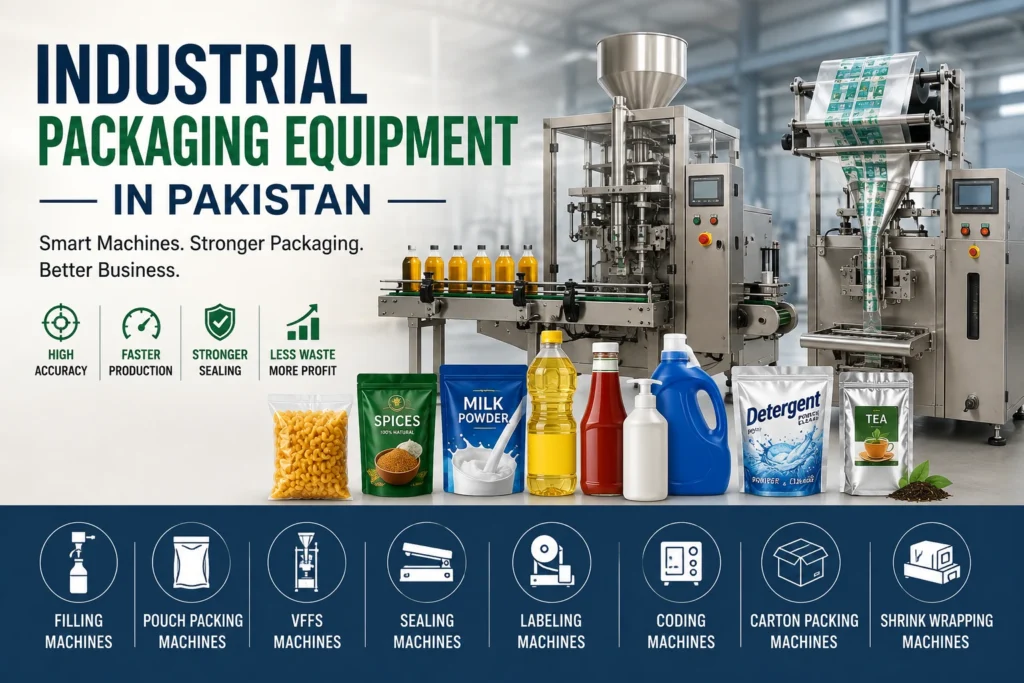
This is why factories use industrial packaging equipment. These machines help businesses pack products faster, cleaner, and with better control. They reduce human error and make the final product look more professional.
In Pakistan, food brands, beverage companies, chemical manufacturers, pharma units, cosmetic brands, agriculture suppliers, textile exporters, and FMCG businesses use packaging equipment for daily production. The machine choice depends on the product, packing style, speed, and factory setup.
What Does Industrial Packaging Equipment Include?
Industrial packaging equipment is not one machine. It includes all machines used in filling, sealing, wrapping, labeling, coding, carton packing, and final dispatch preparation.
A liquid brand may need a filling machine, capping machine, labeling machine, coding machine, and shrink wrapping machine. A snack factory may need a weighing system, pouch packing machine, sealing machine, date printer, and carton packing setup. A powder business may need an auger filler, pouch machine, sealing system, and batch coding machine.
Industrial equipment also connects with the wider food packaging machine in Pakistan category because most factories need different machines for primary packing, secondary packing, and final dispatch.
Every product needs a different packing process. Liquid, powder, granules, snacks, bottles, jars, cartons, and heavy industrial goods cannot use the same setup.
The main purpose is clear: pack products with better accuracy, stronger sealing, cleaner finishing, and less waste.
Why Manual Packing Becomes a Problem
Manual packing looks easy at a small scale. But it becomes difficult when production grows.
Workers may fill different quantities. Some pouches may seal properly, while others may leak. Labels may tilt. Cartons may not close properly. During busy hours, mistakes increase because everyone tries to complete orders quickly.
Manual packing also slows down dispatch. A factory may have enough demand, but poor packing speed limits daily output.
Packaging equipment brings discipline to the line. Machines repeat the same process again and again. They keep filling, sealing, labeling, and wrapping more consistent. This helps the factory manage regular production and large orders with better control.
Filling Machines
Filling machines handle products that need measured quantity in bottles, jars, pouches, sachets, containers, or bags.
Liquid filling machines pack water, juice, oil, syrup, chemicals, cleaners, shampoos, hand wash, cosmetics, and pharmaceutical liquids. The filling system changes with product thickness. Thin liquids need one setup. Thick products like honey, cream, sauce, or paste need another setup.
Businesses that pack oils, juices, syrups, detergents, and cosmetics often start with a liquid filling machine in Pakistan before adding capping, labeling, coding, and shrink wrapping to the same line.
Powder filling machines handle spices, flour, milk powder, detergent, coffee powder, protein powder, and instant mixes. These machines usually need auger filling because powder creates dust and does not flow like liquid.
Granule filling machines pack rice, sugar, seeds, pulses, dry fruits, grains, and similar products. These products need weighing or cup-filling systems depending on accuracy and speed.
Before selecting a filling machine, check product flow, required quantity, container type, and daily production target.
Pouch Packing Machines
Pouch packing machines are common in food, detergent, tea, spice, snack, and FMCG businesses.
These machines make pouches from packaging film or use pre-made pouches, depending on the model. They fill the product, seal the pack, and prepare it for retail sale.
A pouch machine can pack powders, granules, liquids, pastes, snacks, and small solid products. The machine must match the product. A machine for dry snacks will not work the same way for shampoo sachets or spice powder.
Many retail brands use a pouch packing machine when they need clean sachets, stand-up pouches, center-seal packs, or small product packs for shops and distributors.
Pouch packing helps brands create neat retail packs with proper sealing, weight control, and better shelf presentation.
Vertical Form Fill Seal Machines
A vertical form fill seal machine, also called a VFFS machine, forms the pouch from a roll of film. It pulls the film downward, shapes it into a bag, fills the product, seals the pack, and cuts it.
Factories use VFFS machines for chips, nimko, rice, pulses, sugar, powder, dry fruits, frozen food, tea, snacks, and many other products.
For continuous pouch production, a vertical form fill seal machine in Pakistan can handle forming, filling, sealing, and cutting in one flow, especially for factories with regular daily output.
This machine suits businesses that need continuous packing. It works faster than manual pouch sealing and keeps every pack more consistent.
The main things to check are film type, pouch size, sealing strength, product weight, and filling system. A VFFS machine works properly only when the product, film, and filling unit match each other.
Sealing Machines
Sealing machines close pouches, bags, bottles, jars, trays, and containers. A weak seal can damage the product and create customer complaints.
Food products need strong sealing for freshness. Liquids need leak-proof sealing. Pharma and cosmetics products need clean and safe packaging. Industrial products need secure packing for transport.
Common options include band sealers, induction sealers, heat sealers, tray sealers, vacuum sealers, and impulse sealers.
A sealing machine may look simple, but it plays a major role in product quality. Poor sealing can waste the full product, even when filling and packing look fine.
Capping Machines
Capping machines close bottles and containers with proper tightness. Beverage, oil, cosmetics, chemical, and pharma businesses use these machines regularly.
Manual capping creates two common problems. Some caps remain loose and cause leakage. Some caps become too tight and damage the bottle or cap.
A capping machine keeps the closing process more controlled. It improves speed and gives a better finish to bottled products.
For a complete bottle line, factories usually combine filling, capping, labeling, coding, and shrink wrapping.
Labeling Machines
A good label improves product presentation. A tilted or wrinkled label makes even a good product look cheap.
Labeling machines apply labels on bottles, jars, cartons, containers, pouches, and cans. They can apply one-side labels, two-side labels, top labels, or wrap-around labels.
Food, beverage, cosmetic, chemical, and pharma companies use labeling machines when they want clean and repeatable label placement.
Check bottle shape, label size, label material, and speed before choosing a labeling machine.
Coding and Marking Machines
Every product needs proper identification. Batch number, manufacturing date, expiry date, price, and production code help with stock control and market compliance.
Coding machines print these details on pouches, bottles, cartons, labels, and packaging films. Common machines include inkjet coders, laser marking machines, thermal transfer printers, and date coding machines.
Many factories treat coding as a small step, but wrong or missing coding creates serious problems in the market. A good coding system keeps product tracking simple and professional.
Shrink Wrapping Machines
Shrink wrapping machines cover products or product bundles with plastic film. Heat shrinks the film and makes it tight around the product.
Factories use shrink wrapping for water bottle packs, juice bottles, cosmetics, cartons, jars, boxes, trays, and multi-pack bundles.
Shrink wrapping protects products from dust and improves handling. It also gives the final pack a clean look for retail shelves and transport.
Carton Packing and Dispatch Equipment
Primary packaging protects the product directly. Secondary packaging protects the packed product during storage, delivery, and transport.
Carton equipment includes carton sealers, carton taping machines, strapping machines, carton erectors, carton box making machines, and cartoning machines.
A good carton packing setup helps reduce damage during delivery. It also improves stacking, dispatch, and warehouse handling.
Businesses that ship products to dealers, distributors, supermarkets, or export markets need strong carton packing. Weak outer packing can damage the product even when the primary pack is perfect.
Wrapping and Strapping Machines
Wrapping and strapping machines prepare cartons, bundles, and pallets for movement.
Stretch wrapping machines wrap pallets with stretch film. Strapping machines apply plastic or steel straps around boxes and bundles.
Textile exporters, industrial suppliers, carton manufacturers, warehouse operators, and heavy product businesses use these machines for safer transport.
A properly wrapped pallet or strapped carton moves better and reduces the chance of damage.
How to Choose the Right Packaging Equipment
Start with the product. Product behavior decides the machine.
Thin liquid, thick liquid, powder, granules, fragile snacks, bottles, jars, pouches, and cartons all need different handling. Do not select a machine only by looking at photos or videos.
Snack manufacturers need gentle feeding and accurate weighing, so a snack packaging machine works better for chips, nimko, biscuits, and dry snacks than a general-purpose packing setup.
Check the packing style next. Decide whether the product needs a pouch, bottle, jar, sachet, tray, carton, bag, or shrink bundle.
Then check speed. A small unit can start with semi-automatic equipment. A factory with daily bulk orders needs automatic machines or a complete line.
Also check factory space, electricity, compressed air, operator skill, spare parts, and after-sales support. A machine should fit your actual production area, not only your expected output.
Share product samples and packing material with the supplier before final selection. This helps avoid wrong machine selection.
Industrial Packaging Equipment Price in Pakistan
Industrial packaging equipment price in Pakistan changes with machine type, production speed, automation level, build quality, and product compatibility.
A simple band sealer costs much less than a full automatic filling line. A semi-automatic liquid filler costs less than a complete bottle filling, capping, labeling, and coding line. A basic pouch machine costs less than a high-speed VFFS machine with multi-head weighing.
Price usually depends on machine size, stainless steel quality, PLC controls, servo system, filling accuracy, sealing system, imported parts, installation support, spare parts, and service availability.
Do not buy only because the price looks low. A cheap machine can create daily waste, weak sealing, wrong filling, downtime, and maintenance headaches.
A better quotation comes after clear details. Share the product type, required pack size, daily target, packing material, and budget range.
Common Mistakes Buyers Make
Many buyers purchase machines without testing the product. This creates problems later because the product may not flow, fill, seal, or move properly.
Some buyers ignore packaging material. The machine and material must work together. Poor film, weak bottles, low-quality labels, or wrong sealing material can disturb the complete packing process.
Some buyers also choose a machine only for current production. A machine with slightly better capacity can support future growth and delay another investment.
Factory layout also matters. Machines need space for workers, raw material, finished goods, cleaning, maintenance, and movement.
Machines for Powder and Granule Products
Powder and granule products need special attention because they do not behave like liquids or solid items.
Spices, flour, milk powder, detergent powder, coffee powder, and powdered mixes need controlled filling because dust can affect sealing and machine performance. For these products, a powder packing machine in Pakistan can manage filling more accurately when the machine uses the right auger, pouch size, and sealing system.
Rice, sugar, pulses, seeds, grains, and dry fruits need weighing accuracy and smooth product flow. A granule packing machine in Pakistan helps factories pack these products in pouches, bags, and retail packs with better consistency.
Both categories need product testing before final machine selection because weight, flow, dust, and particle size directly affect packing quality.
Maintenance Tips
Packaging machines need regular cleaning and basic care.
Clean product-contact parts after production. Check filling nozzles, sealing jaws, heaters, cutters, belts, rollers, sensors, and moving parts. Lubricate the machine according to the manual.
Keep spare parts available. Common spare parts include heaters, blades, belts, bearings, sensors, nozzles, sealing parts, and electrical components.
Train the operator properly. Many machine faults happen because of wrong settings, forced operation, or poor cleaning.
A clean and well-maintained machine runs better and wastes less material.
Why Choose Micro Star Machines?
Micro Star Machines helps businesses choose the right packaging equipment according to product type, packing style, production target, and budget.
The team can guide you for filling machines, pouch packing machines, sealing machines, labeling machines, coding machines, wrapping machines, carton equipment, and complete packaging lines.
Every product needs a practical setup. Tea, snacks, powder, granules, liquids, bottles, cartons, and industrial goods all need different machines. Micro Star Machines helps match the machine with your actual factory requirement.
The team also supports machine selection, installation guidance, spare parts, and technical assistance.
Get Industrial Packaging Equipment in Pakistan
Industrial packaging equipment helps factories improve packing speed, product finishing, sealing quality, and production control. It also reduces manual mistakes and supports larger orders.
Share your product type, packing style, required speed, packaging material, and daily production target with Micro Star Machines. The team will recommend suitable industrial packaging equipment according to your business needs.
Contact Micro Star Machines today and choose the right industrial packaging equipment in Pakistan for your food, beverage, chemical, pharma, cosmetics, agriculture, textile, or manufacturing business.