
Packaging does not only protect a product. It also sells it. A plain pouch, carton, wrapper, or label may carry the product, but printed packaging builds trust before the customer even opens it.
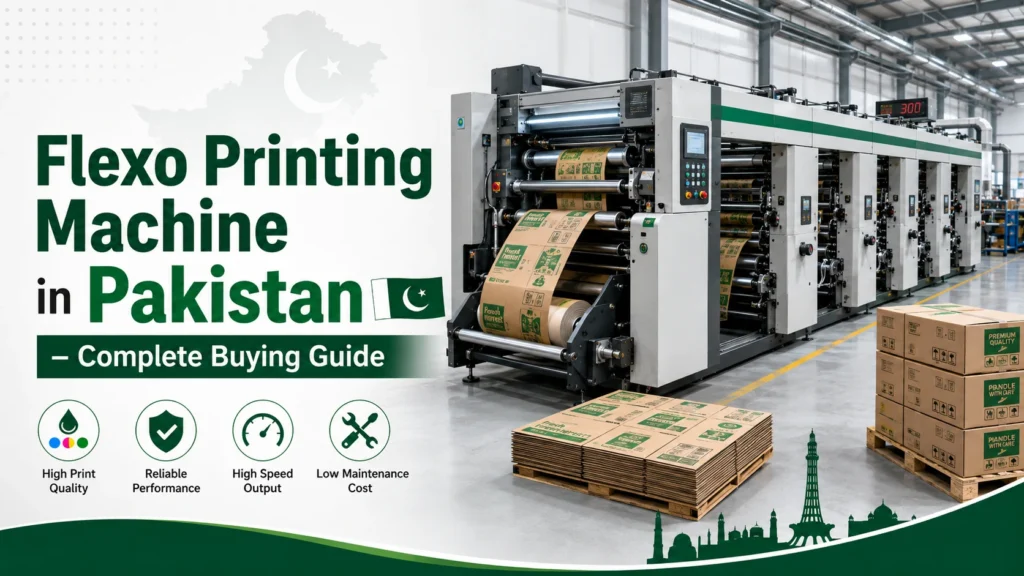
That is why many packaging businesses, food brands, carton manufacturers, label suppliers, and FMCG companies use flexo printing machines. These machines print logos, product details, colors, barcodes, and branding directly on packaging material. In Pakistan, flexo printing is commonly used for cartons, labels, shopping bags, wrappers, pouches, flexible film rolls, paper bags, and non-woven bags.
A flexo printing machine gives businesses the speed and consistency they need for commercial printing. It handles bulk jobs better than manual or low-grade printing methods and helps brands keep their packaging clean, readable, and professional.
Flexo Printing Machine: Basic Meaning
A flexo printing machine uses flexible printing plates to transfer ink onto packaging material. The machine carries the material through the printing rollers, applies ink from the plate, and prints the required design onto the surface.
This method works on many materials, including paper, cardboard, corrugated board, plastic film, foil, labels, and non-woven fabric. That is why flexo printing plays a big role in the broader food packaging machine in Pakistan market, where food brands need printed pouches, cartons, labels, wrappers, and rolls for retail packing.
The machine can print simple one-color logos or detailed multi-color packaging designs. A small business may use it for basic carton printing, while a large packaging company may use a 4-color, 6-color, or 8-color machine for flexible packaging rolls and labels.
How Flexo Printing Works
Flexo printing follows a simple but accurate process.
First, the design is prepared on a flexible printing plate. The operator mounts this plate on the printing cylinder. The machine then supplies ink through rollers. The anilox roller controls the amount of ink and transfers it to the plate.
As the material passes through the machine, the plate presses the design onto the surface. After printing, the material passes through a drying section so the ink settles properly.
For multi-color jobs, every printing unit adds one color. A 4-color machine uses four printing units. Each unit must align correctly with the previous one. This alignment is called registration, and it matters a lot in packaging print quality.
Factories that already use an automatic packaging machine in Pakistan often need printed packaging rolls, labels, or cartons before the product reaches the final packing stage.
Where Businesses Use Flexo Printing
Flexo printing supports many industries because it works with both roll and sheet materials.
Packaging companies use it for printed film rolls, labels, wrappers, pouches, paper bags, and non-woven bags. Carton manufacturers use it to print brand names, symbols, and handling instructions on corrugated sheets. Food brands use it for snack packaging, bakery bags, spice pouches, tea envelopes, labels, and retail cartons.
Beverage, oil, cosmetic, and chemical businesses using a liquid filling machine in Pakistan also need printed labels, shrink sleeves, bottle cartons, and outer packaging for distribution.
The machine is also useful for pharma labels, textile packaging, courier bags, grocery bags, shopping bags, and export packaging.
Types of Flexo Printing Machines
Different businesses need different flexo machines. The right machine depends on your material, number of colors, printing width, speed, and finishing needs.
Stack Type Flexo Printing Machine
A stack type flexo machine has printing units arranged vertically. Each unit prints one color. This type works well for plastic film, paper, woven sacks, non-woven bags, and flexible packaging material.
It suits businesses that need 2-color, 4-color, 6-color, or 8-color printing with decent speed and material flexibility.
Central Impression Flexo Machine
A central impression machine, also called a CI flexo machine, uses one large central drum. The material stays stable around this drum while each color prints on it.
This machine gives better registration, especially on flexible films. Packaging companies use it for food wrappers, flexible pouches, shrink sleeves, and high-quality printed rolls.
Inline Flexo Printing Machine
An inline flexo machine arranges the printing units in a straight line. The material moves from one unit to the next.
This setup works well for labels, cartons, and packaging that may need extra processes like coating, die cutting, slitting, or rewinding. Label manufacturers often prefer this type because they can print and finish labels in one line.
Carton Flexo Printing Machine
A carton flexo printing machine prints on corrugated sheets and carton board. It can print logos, product names, handling marks, batch details, and shipping instructions.
Carton box manufacturers, food suppliers, textile exporters, e-commerce suppliers, and industrial packaging companies commonly use this machine. Some carton flexo machines also include slotting or die-cutting sections.
Label Flexo Printing Machine
A label flexo machine prints product labels on roll material. It is used for food labels, medicine labels, cosmetic labels, beverage labels, barcode labels, and sticker labels.
Many label machines also include lamination, die cutting, slitting, and rewinding options.
Paper Bag and Non-Woven Bag Flexo Machine
Paper bag flexo machines print on paper rolls or finished paper bags. Non-woven bag flexo machines print on fabric-style shopping bags.
These machines support retail packaging, bakery bags, grocery bags, promotional bags, pharmacy bags, and branded shopping bags.
Materials You Can Print
A flexo printing machine can print on paper, kraft paper, cardboard, corrugated sheets, plastic film, BOPP film, PE film, PVC film, foil, stickers, labels, woven sacks, non-woven fabric, and laminated rolls.
Snack brands using a snack packaging machine often need printed film rolls for chips, nimko, biscuits, dry snacks, and bakery items.
Tea brands using a tea bag packing machine in Pakistan may need printed outer envelopes, tea cartons, labels, and retail display boxes.
Material selection matters because every surface reacts differently. Plastic film needs proper tension control and drying. Paper absorbs ink differently. Corrugated board needs pressure control. Labels need sharp printing and clean rewinding.
Flexo Printing vs Offset Printing
Offset printing works well for books, brochures, catalogs, posters, and flat paper sheets. It gives excellent print quality on paper.
Flexo printing works better for packaging. It prints on rolls, films, labels, cartons, paper bags, foil, and flexible packaging material. It also supports faster production for packaging jobs.
For a packaging business, flexo printing usually makes more sense than offset printing because it handles more materials and packaging formats.
Flexo Printing vs Gravure Printing
Gravure printing gives high-quality results and works well for very large production runs. It uses engraved cylinders, which cost more to prepare.
Flexo printing uses flexible plates, so it gives more flexibility for changing designs and handling different order sizes. Many Pakistani businesses prefer flexo because it balances cost, speed, and quality.
Gravure suits very large orders with the same design. Flexo suits businesses that handle different customers, different packaging materials, and frequent design changes.
Specifications to Check Before Buying
Do not choose a flexo printing machine only by price. Match the machine with your work.
Start with the number of colors. A one-color or two-color machine can handle simple carton printing or basic bag printing. For retail pouches, labels, and attractive packaging, 4-color or 6-color printing works better.
Check the printing width next. Narrow web machines work for labels. Wider machines work for packaging rolls, paper bags, plastic film, and large printed material.
Printing speed also matters, but speed alone does not decide quality. The machine must hold registration, dry ink properly, control tension, and handle your material without wrinkles.
Also check the ink system, drying system, plate mounting system, rewinding unit, unwinding unit, and tension control. These parts directly affect final print quality.
For powdered food, spices, detergent, and instant mix brands using a powder packing machine in Pakistan the printed roll must match the packing machine’s sealing and forming requirements.
Similarly, rice, sugar, pulses, seeds, and grains packed through a granule packing machine in Pakistan need strong printed film that can handle product weight, sealing heat, and transport pressure.
Flexo Printing Machine Price in Pakistan
Flexo printing machine price in Pakistan depends on the machine type, printing width, number of colors, speed, automation level, and material compatibility.
A basic one-color or two-color machine costs less. A 6-color or 8-color machine with better registration, drying, tension control, and PLC controls costs more. A carton flexo machine, label flexo machine, CI machine, and stack-type machine all have different pricing.
Price also changes with machine body quality, servo system, ink control, drying system, imported parts, installation support, spare parts, and after-sales service.
A low-price machine may look attractive at first, but poor registration, weak drying, and limited material handling can increase waste. Always share your material, printing width, number of colors, and daily production target before asking for a final quotation.
Common Flexo Printing Problems
Flexo printing needs correct settings. Small mistakes can damage the full print job.
Color variation happens when ink viscosity, roller pressure, or machine settings keep changing. Poor registration makes the design look blurred. Weak drying causes smudging. Bad plate mounting creates unclear print. Poor tension control creates wrinkles, especially on thin films.
Operators can reduce most of these issues by using the right ink, correct pressure, clean rollers, proper plates, and stable machine settings.
Maintenance Tips
Clean the ink system after production. Dried ink can block rollers and affect print quality.
Check anilox rollers regularly because blocked cells reduce ink transfer. Keep plates clean and store them properly. Inspect drying units, belts, bearings, cylinders, gears, and rewinding systems.
For roll-to-roll machines, tension control needs regular checking. Poor tension causes wrinkles, shifting, and material waste.
Keep spare parts available, especially belts, rollers, bearings, sensors, blades, and electrical parts. Also train operators properly because many printing issues start with wrong pressure settings or poor ink handling.
Get the Right Flexo Printing Machine in Pakistan
A flexo printing machine can help you produce clean, branded, and market-ready packaging. It supports different materials, handles bulk printing, and improves packaging consistency.
Share your material type, printing width, number of colors, design requirements, and daily production target with Micro Star Machines. The team will recommend a suitable flexo printing machine according to your business needs.
Contact Micro Star Machines today and choose the right flexo printing machine in Pakistan for your packaging, carton, label, paper bag, or flexible printing business.
Pingback: Flexo Printing Machine Supplier in Pakistan - Micro Star Machines
Pingback: Corrugated Box Factory Setup in Pakistan - Micro Star Machines
Pingback: 3 Ply Corrugated Box Production Line in Pakistan - Micro Star Machines
Pingback: 3 Ply vs 5 Ply Corrugated Production Line: Which Is Right for Your Factory? - Micro Star Machines