
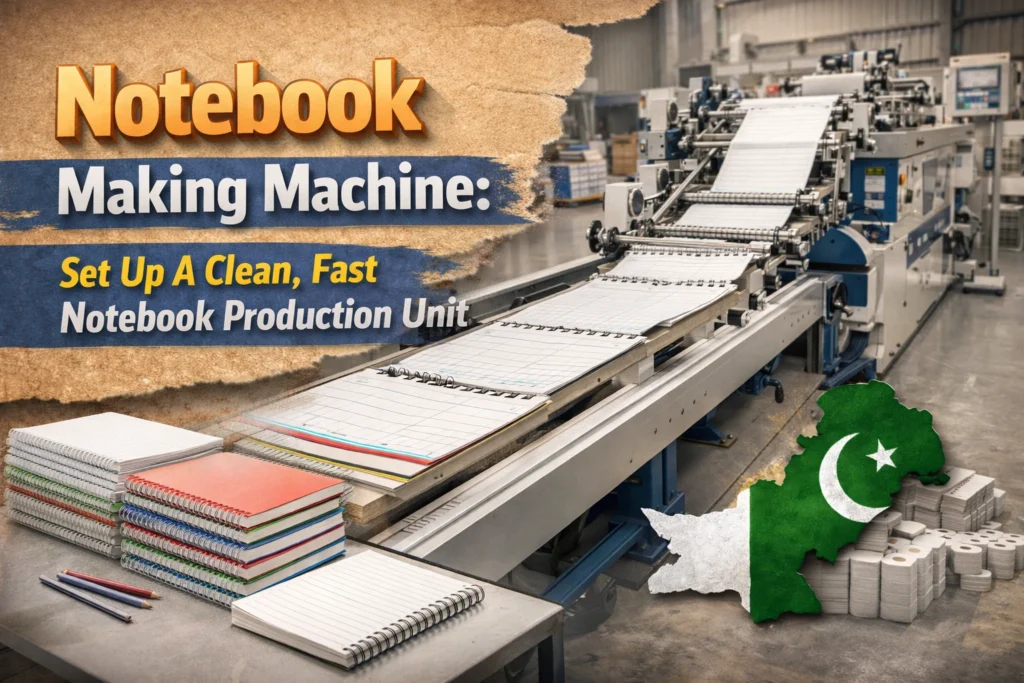
Back-to-school season doesn’t wait. When dealers start calling for copies, registers, and exercise books, you either deliver on time—or someone else takes the order. A solid notebook making machine setup lets you manufacture notebooks at scale with consistent cutting, neat stitching, and a clean finish that looks good on the shelf.
Micro Star Machines builds industrial machinery with a clear focus: durability, stable performance, long service life, and smooth production. We also support customers beyond the sale with engineering and maintenance support so production stays steady.
This guide breaks the notebook line into practical, real-world parts—no fluff, no theory.

What You Actually Produce
“Notebook” covers a lot:
- School copies (exercise books)
- Registers (single or multi-quire)
- Diaries / journals
- Office notebooks
- Custom branded notebooks for institutions
The product decides everything: page count, size (A4/A5/ledger), cover type, binding style, and finishing.
The Workflow: From Printed Sheets To Finished Copies
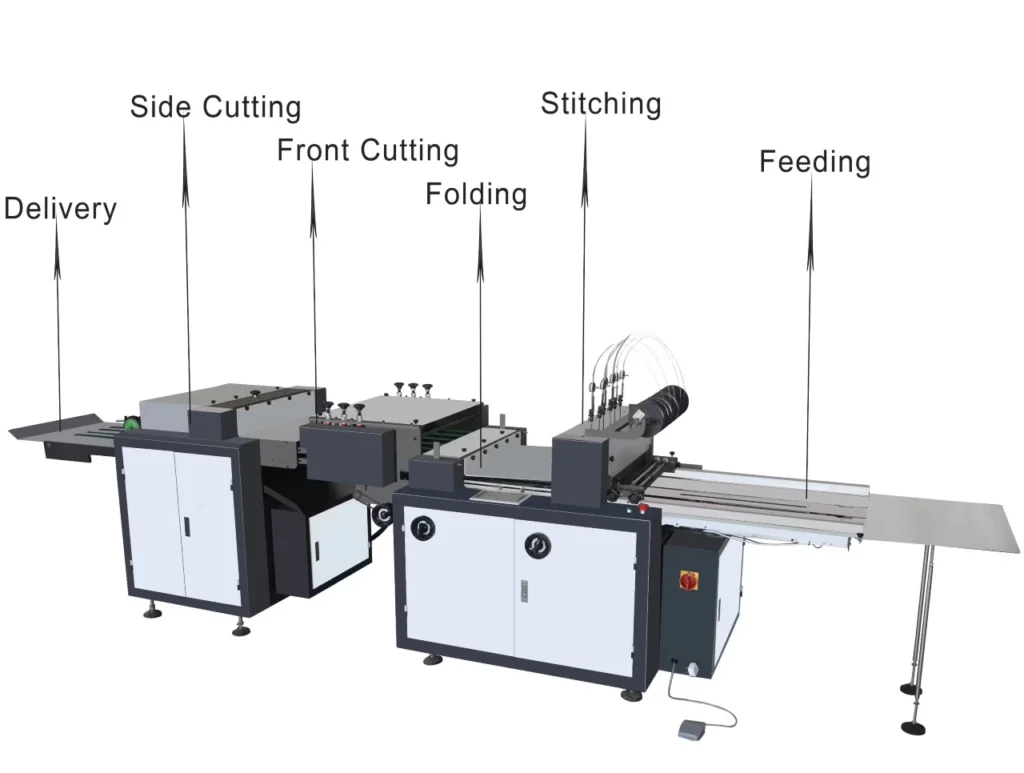
A notebook unit runs like a simple chain. Each step needs clean alignment, repeatable pressure, and fast handling:
- Cutting / Sheet Sizing
- Folding Or Gathering (depending on format)
- Stitching / Stapling (center or side)
- Cover Feeding / Cover Pasting (for many styles)
- Pressing (to set shape and remove air gaps)
- Edge Squaring (clean spine/edges)
- Trimming (final size and neat corners)
- Stacking & Packing
You can build this as a compact semi-automatic setup or a more automated line. The right choice depends on volume, labor availability, and how many notebook variants you plan to run daily.
Machines That Do The Heavy Lifting
Cutting drives your final look. When cutting drifts, every downstream station fights alignment. A dependable cutting solution keeps sheet sizes consistent and reduces waste.
Look for:
- Stable back gauge movement
- Clean cut edges (no tearing or feathering)
- Easy blade maintenance access
Stitching That Doesn’t Misfire
Stitching isn’t just “put two staples and go.” A weak clinch or misaligned staple ruins the book instantly. A strong stitching station keeps staples centered and tight.
Most notebook lines use:
- Center stitching for exercise books
- Side stitching for thicker registers
Pressing That Gives The Notebook Its Shape
Pressing makes the notebook feel “finished.” It flattens the book, sets the folds, and improves stack quality.
Edge Squaring That Makes It Look Premium
This step changes the product’s market value. Edge squaring cleans the back edge and improves stacking for packing. Schools and distributors notice the difference immediately.
Trimming That Produces Clean Corners
Trim after squaring to get a sharp, consistent final size. You’ll also reduce complaints about uneven edges and ugly corners.
Common Setup Styles
Here are the three common setups. Pick one setup from these three and build around it.
Lean Workshop Setup
A practical option for small-to-mid production with more manual handling. It fits in tighter spaces and stays easier to maintain.
Balanced Semi-Automatic Line
This setup speeds up stitching, squaring, and trimming while keeping costs under control. It works well for mixed SKUs (A4/A5, different page counts) because operators can change jobs quickly.
Higher-Output Line
This option focuses on repeat production and fewer changeovers. It suits factories that run the same sizes daily and want volume consistency.
Quality Checks That Save You From Returns
Notebook buyers don’t write long emails. They just reject stock.
Keep these checks on the floor:
- Squareness: covers and pages align on all sides
- Stitch Position: staples stay centered and consistent
- Page Count Accuracy: no missing gathers
- Trim Finish: clean corners, no burrs, no uneven edges
- Press Finish: notebook lays flat, doesn’t spring open
- Stack Quality: neat stacks pack faster and ship cleaner
A supervisor with a simple checklist prevents most rework.
Layout Tips From The Factory Floor
A notebook unit runs better when you plan flow and handling:
- Keep cutting near the paper storage area
- Move finished stacks away from dust and cutting scrap
- Leave clear space near stitching and trimming (operators need room)
- Plan a packing zone that doesn’t block machine movement
- Store consumables (wire, glue, packing material) close to the line
Small layout decisions save hours every week.
Support, Maintenance, And Spares Matter More Than Brochures
Notebook production doesn’t stop because you “need a part.” It stops because nobody planned support.
Micro Star Machines provides industrial machinery and positions itself as a one-stop provider across machinery categories. We also emphasize service coverage—from engineering support to regular maintenance, before and after sale. That matters when you run daily production and want predictable uptime.
Get A Notebook Making Machine Setup From Micro Star Machines
Share your target notebook types (exercise books / registers / diaries), your sizes (A4/A5), binding style (center/side), and daily output target. We’ll recommend a practical setup and a clean factory flow that suits your space.
Phone: +92 (0) 41 8861153
Email: info@microstarmachines.com
Where to get paper makign machines?