
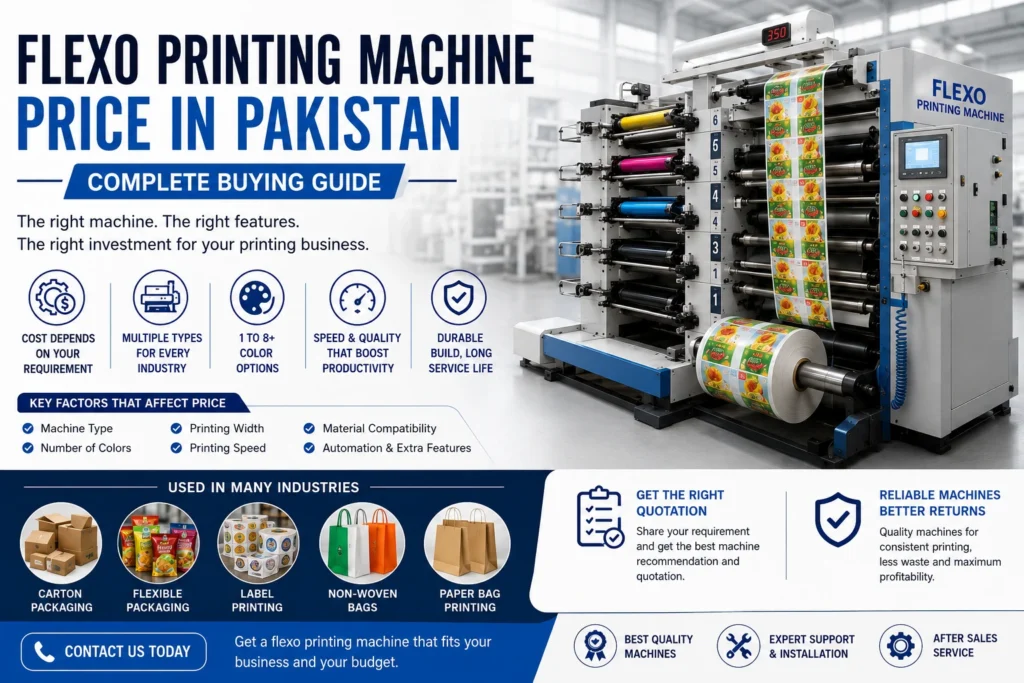
People usually search for the flexo printing machine price when they are close to buying. They already know they need printing equipment, but they want to understand the budget before contacting a supplier.
The problem is simple. A flexo printing machine does not come with one fixed price. The cost changes with machine type, number of colors, printing width, material, speed, automation level, and extra features. A machine for basic carton printing will not cost the same as a high-speed multi-color machine for flexible packaging rolls.
That is why the right way is to get a quotation after sharing your actual printing requirement. A quotation gives a more realistic idea because the supplier can match the machine with your material, width, colors, and production target.
This guide explains the main factors that affect the flexo printing machine price in Pakistan, without giving random or misleading figures.
Why the Flexo Printing Machine Price is Not Fixed
A flexo printing machine can serve many industries. Carton factories use it for corrugated boxes. Food packaging companies use it for wrappers and pouches. Label suppliers use it for product stickers. Paper bag manufacturers use it for retail bags. Non-woven bag makers use it for shopping bags and promotional bags.
Each business needs a different machine setup.
One buyer may need a simple one-color machine for carton marking. Another may need a six-color machine for printed food packaging. A label printer may need die cutting, slitting, and rewinding. A flexible packaging company may need better tension control, drying, and registration accuracy.
So, the supplier cannot give one price for everyone. The machine has to match the work.
Machine Type Affects the Quotation
The first thing that changes the quotation is the machine type.
A carton flexo printing machine prints on corrugated sheets and carton board. It is commonly used by carton manufacturers, e-commerce suppliers, food brands, textile exporters, and industrial packaging businesses.
A stack-type flexo printing machine prints on plastic film, paper, woven sacks, non-woven bags, and flexible packaging rolls. It is useful for general packaging work and multi-color printing.
A CI flexo printing machine gives better registration for flexible films. Packaging companies use it for high-quality printed rolls, food wrappers, shrink sleeves, and pouch materials.
A label flexo printing machine prints labels and stickers on rolls. It may also include lamination, die cutting, slitting, and rewinding.
A paper bag flexo printing machine prints on paper rolls and paper bags. Retail packaging, bakery bags, grocery bags, and shopping bags usually need this type.
Every machine type has a different structure, printing system, and production use. That is why the quotation changes from one model to another.
Number of Colors Matters
Color option is one of the biggest price factors.
A one-color flexo printing machine works for simple logos, basic carton printing, shipping marks, and plain text. A two-color machine gives more branding flexibility. Four-color machines are common for better retail packaging. Six-color and eight-color machines handle more detailed designs and premium packaging jobs.
More colors mean more printing units, more rollers, more controls, and more setup requirements. The machine becomes more advanced as the number of colors increases.
For basic carton printing, fewer colors may be enough. For food pouches, snack packets, labels, and flexible packaging, brands usually need more colors for attractive shelf presentation.
Printing Width Changes the Cost
Printing width decides how wide the material can pass through the machine.
A narrow web machine works for labels and stickers. A wider machine works for packaging rolls, shopping bags, paper bags, plastic films, woven sacks, and large carton printing.
Wider machines need a stronger frame, larger rollers, better tension control, and more stable material handling. This naturally changes the quotation.
Before asking for a price, decide the required material width. Share the maximum roll width or sheet size with the supplier. This helps them recommend a suitable machine instead of guessing.
Printing Speed Also Plays a Role
Speed affects production capacity and machine cost.
A slower machine can work for small printing jobs, local orders, or low-volume production. A faster machine suits factories that handle regular commercial orders and bulk printing.
But speed alone should not guide the buying decision. A fast machine must also maintain print quality. It should control registration, ink transfer, drying, and material movement properly.
A machine that runs fast but wastes material is not a good investment. The right machine should balance speed with stable printing.
Material Compatibility is Very Important
Flexo printing machines print on different materials, but one machine cannot handle every material perfectly.
Paper, kraft paper, carton board, corrugated sheets, plastic film, BOPP, PE, PVC, foil, labels, non-woven fabric, and laminated rolls all behave differently during printing.
Plastic film needs proper tension control because it can stretch or wrinkle. Corrugated board needs pressure control because extra pressure can damage the sheet. Labels need sharp printing, clean rewinding, and accurate die cutting. Non-woven fabric needs a machine that can handle its surface properly.
Material compatibility directly affects the quotation because the machine may need special rollers, drying, tension control, or feeding systems.
Drying System and Ink Setup
Ink needs proper drying after printing. Weak drying creates smudging, sticking, and poor finishing.
A basic machine may have a simple drying system. A high-speed machine needs stronger drying because the material moves faster. Plastic films and laminated materials need better drying compared to basic paper printing.
The ink system also affects print quality. A good anilox roller, controlled ink transfer, and stable ink flow help produce sharp and consistent printing.
For businesses that print food packaging, labels, or premium pouches, drying and ink control become more important.
Registration Accuracy
Registration means color alignment. In multi-color printing, each color must sit in the correct position. Poor registration makes the design look blurred or shifted.
Basic one-color carton printing does not need complex registration control. Multi-color packaging, labels, and flexible film printing need better accuracy.
Machines with stronger registration control, better tension systems, and advanced controls usually cost more. But they also reduce waste and improve final print quality.
Automation Level
Flexo machines come in different automation levels.
Some machines need more manual adjustment. Others include PLC controls, touch screen systems, automatic tension control, web guiding, automatic counting, and better speed control.
Automation improves production handling and reduces operator error. It also makes the machine more expensive.
A small business may start with a simpler setup. A large packaging company may need more automation because it handles daily production and repeat orders.
Extra Features That Change the Quotation
Many buyers only ask for the base machine price, but extra features can change the final quotation.
Common add-ons include:
- Web guiding system
- Corona treatment
- Better drying system
- Lamination unit
- Die cutting unit
- Slitting unit
- Rewinding system
- Servo controls
- Touch screen controls
- Automatic tension control
- Extra color stations
- Custom printing width
- Special material handling
These features are useful when they solve a real production need. Extra features without purpose only increase the budget.
Imported vs Local Machine
The source of the machine also affects the quotation.
Imported machines usually cost more because of shipping, duties, exchange rate, and imported components. Local or locally supplied machines may offer easier communication, quicker service, and better support access.
The better choice depends on the buyer’s work. A simple carton printing setup may not need the most expensive imported option. A high-quality flexible packaging setup may need better controls and advanced components.
The supplier should explain the difference clearly so the buyer can compare value, not just price.
Spare Parts and After-Sales Support
A flexo printing machine works in daily production. Downtime affects orders, delivery, and customer trust.
That is why spare parts and support matter in the total cost. A machine with low purchase cost but poor service support can become expensive later. Rollers, belts, bearings, sensors, ink parts, drying parts, and electrical components should be available when needed.
Before finalizing any quotation, ask about installation, operator guidance, spare parts, and technical support.
Details Needed for an Accurate Quotation
A supplier can give a better quotation when the buyer shares clear information.
Prepare these details before requesting a flexo printing machine quotation:
- Material type
- Roll or sheet printing
- Required printing width
- Number of colors
- Printing speed requirement
- Product type
- Design complexity
- Required finishing options
- Available factory space
- Power setup
- Daily production target
These details save time and reduce wrong machine suggestions.
Avoid Random Price Comparisons
Many buyers compare flexo printing machines only by price. That creates confusion because two machines may look similar but perform very differently.
One machine may have better registration. Another may have stronger drying. One may support more materials. Another may have better tension control. One may include after-sales support. Another may only include the basic machine.
A proper comparison should include machine type, build quality, color units, width, speed, controls, material compatibility, support, and spare parts.
A lower quotation is not always a better deal. A higher quotation is not always necessary either. The right quotation matches the printing job.
Why Choose Micro Star Machines?
Micro Star Machines helps businesses choose flexo printing machines according to their material, printing width, number of colors, speed, and production requirements.
The team can guide buyers for carton printing, label printing, paper bag printing, non-woven bag printing, plastic film printing, and flexible packaging applications.
Instead of giving one fixed price for every buyer, Micro Star Machines recommends a machine after understanding the printing work. This helps buyers get a practical quotation for their actual requirement.
Get a Flexo Printing Machine Quotation in Pakistan
Flexo printing machine price in Pakistan depends on machine type, colors, width, speed, material, automation, and finishing options. A proper quotation gives a clearer picture than a random price estimate.
Share your printing material, required width, number of colors, design type, and daily production target with Micro Star Machines. The team will recommend a suitable machine and provide a quotation according to your business needs.
Contact Micro Star Machines today to get a quotation for a flexo printing machine in Pakistan for carton printing, label printing, paper bags, non-woven bags, plastic film, and flexible packaging.