
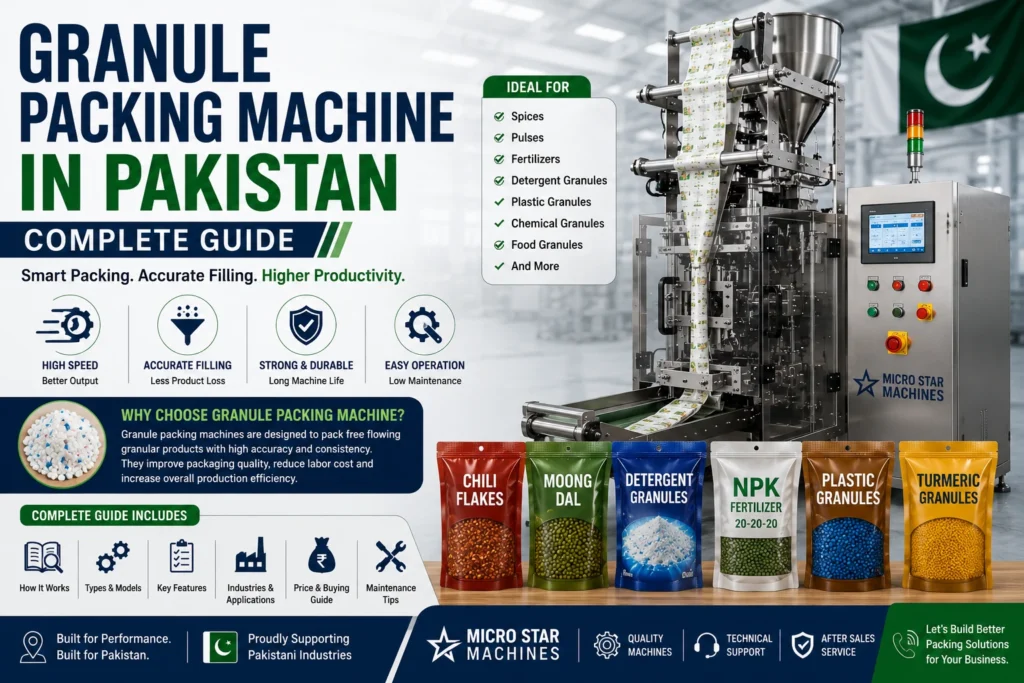
Packaging is no longer just about filling products into pouches and sealing them. In industries like food, agriculture, pharmaceuticals, and chemicals, packaging directly affects production speed, product consistency, shelf presentation, and daily operations inside the factory.
That is why granule packing machines are now common in production facilities across Pakistan. Rice manufacturers, tea brands, seed suppliers, spice companies, Nimco businesses, detergent manufacturers, and fertilizer companies all require packaging systems that can handle production continuously without creating unnecessary wastage or slowing down operations.
Manual packing still works for very small setups, but once production increases, manual handling starts creating problems. Different pouch weights, slow output, product spilling, poor sealing, and labor dependency start affecting both production and packaging quality.
A granule packing machine handles these tasks in a structured way. The machine measures the product, forms the pouch, fills it, seals it, and cuts it automatically. Production becomes more organized, and packaging starts looking consistent across every pouch.
What Is a Granule Packing Machine?
A granule packing machine packs products that come in grain, particle, or granule form. Unlike powder packing systems, these machines handle products with visible particle structure.
Factories in Pakistan commonly use these machines for:
- Rice
- Sugar
- Salt
- Tea
- Seeds
- Pulses
- Nimco
- Dry fruits
- Detergent granules
- Fertilizer granules
Most modern machines combine weighing, filling, sealing, and cutting into one automated system. Operators only need to manage product feeding and monitor machine performance during production.
Industries Using Granule Packing Machines in Pakistan
Different industries use granule packing machines differently depending on their production scale and product type.
Food companies usually require fast packaging with clean pouch finishing because products go directly to retail shelves. Rice, pulses, nimco, spices, and tea manufacturers often use VFFS granule packing systems for continuous production.
Agriculture businesses focus more on accurate filling because seed and fertilizer packaging requires proper weight consistency. In this sector, even small filling errors create problems during bulk distribution.
Pharmaceutical manufacturers use granule packing systems where hygienic production and precise quantity control matter more than production volume.
Chemical industries use these machines for detergent granules and industrial materials where manual packaging becomes difficult during high-volume production.
Types of Granule Packing Machines
Not every factory requires the same machine setup. Production volume, pouch size, automation level, and product type all affect machine selection.
Automatic Granule Packing Machines
Factories running continuous production lines usually prefer fully automatic systems. These machines handle the complete packaging cycle automatically without manual pouch handling.
The operator feeds the product and monitors the machine while the system manages:
- weighing
- pouch forming
- filling
- sealing
- cutting
These machines work well for large-scale production facilities where speed matters.
Semi-Automatic Machines
Small businesses and startup brands often begin with semi-automatic systems. These machines reduce labor work but still require some manual operation during filling or pouch placement.
They suit businesses that want better packaging without investing in large industrial systems immediately.
VFFS Granule Packing Machines
Vertical Form Fill Seal machines are widely used in Pakistan because they support different pouch styles while maintaining good production speed.
The machine forms pouches directly from roll film, fills the product, seals the pouch, and cuts it continuously during operation.
Most food packaging factories prefer VFFS systems because they handle retail packaging efficiently.
Multihead Weigher Systems
Products like dry fruits, snacks, tea, and premium food items usually require more accurate weighing systems.
Multihead weighers distribute the product properly before filling, which improves both speed and weight consistency during production.
Packaging Styles Used for Granule Products
Different pouch styles serve different markets. Some businesses focus on cost-efficient retail packaging while others require stronger or more premium pouch structures.
Center seal pouches remain common for tea, spices, and small retail products because they keep packaging simple and cost-effective.
Pillow pouches are widely used for rice, sugar, pulses, and snack products because factories can produce them quickly during large production runs.
Three-sided and four-side seal pouches provide a cleaner and more structured appearance. Businesses selling premium products often use these packaging styles for better shelf presentation.
Gusset bags work better for larger product quantities because they provide extra storage space and better standing support.
How a Granule Packing Machine Works
Most granule packing machines follow the same production flow even though machine designs vary.
The process starts from the feeding section where operators load the raw product into the hopper.
The weighing system then measures the required quantity before the machine pulls the packaging film downward. The machine forms the pouch shape, fills the measured product, seals the pouch using heat sealing systems, and cuts the final pouch automatically.
The entire cycle runs continuously during production.
Machine speed depends on:
- pouch size
- product type
- filling system
- machine configuration
Why Many Factories Prefer Automatic Packaging
Factories that shift from manual packing to automatic packaging usually do so because production becomes difficult to manage manually once order volume increases.
Automatic packaging systems help maintain:
- consistent pouch weight
- cleaner sealing
- organized production flow
- faster packaging output.
Labor dependency also decreases because one operator can manage work that previously required several workers.
For food businesses, packaging consistency also matters on retail shelves. Products with uneven filling or poor sealing create a weak impression even when the actual product quality is good.
Choosing the Right Granule Packing Machine
Many businesses make the mistake of selecting machines based only on price.
The first thing to evaluate is production capacity. A machine suitable for a small startup may struggle inside a factory running continuous shifts.
Product type matters too. Tea, rice, seeds, detergent granules, and fertilizer materials all behave differently during filling. Some products require more accurate weighing systems while others need stronger feeding mechanisms.
Pouch dimensions also affect machine setup. A business producing multiple pouch sizes needs a flexible machine configuration instead of a fixed system.
Machine construction should also remain practical for industrial use. Stainless steel body structure, accessible maintenance areas, and proper electrical systems matter more during long-term operation than basic cosmetic appearance.
Local spare parts support also plays a major role. Production delays become expensive when factories cannot access machine parts or technical support quickly.
Granule Packing Machine Price in Pakistan
There is no single fixed price for granule packing machines because machine configurations vary heavily.
Several factors affect pricing:
- production speed
- automation level
- weighing technology
- imported electronic components
- servo systems
- pouch styles
- and customization requirements
Machines designed for large-scale production naturally cost more because they handle higher output and include more advanced automation systems.
Businesses should focus more on production requirements and machine reliability instead of comparing machines only on initial price.
Why Businesses Choose Micro Star Machines
Micro Star Machines works with industries that require practical packaging systems for daily production environments.
The company provides packaging machinery for:
- food industries
- agricultural businesses
- chemical manufacturers
- industrial production facilities
Machine support, installation guidance, spare parts availability, and production-focused configurations matter just as much as the machine itself during factory operations.
Every production setup runs differently, which is why machine selection should match actual production requirements instead of generic specifications alone.